
What to Know
- WTI and Brent rallied 8% last week, with more than 6% of the move coming on Thursday alone.
- Friday’s selloff followed market chatter around a possible temporary shipping agreement with Iran, but the expected meeting between Iran and Gulf countries is now off.
- WTI settled Friday at $100.05, down $2.43 or 2.37%, while Brent closed at $104.61, down $3.02 or 2.81%.
- Monday’s trading erased Friday’s decline as supply risk returned to the center of the crude oil market.
- Saudi state media showed damage to homes and a mosque in Jazan province after weekend attacks.
- The Houthis struck a Saudi military base in a neighboring province and reached the strategic island of Perim near the Bab el-Mandeb Strait on Friday.
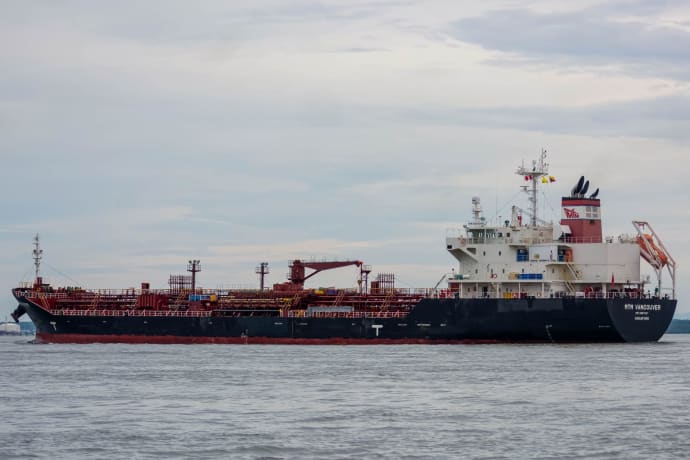
- In the Strait of Hormuz, a vessel was hit by a projectile that started a fire and forced the crew to evacuate, while a projectile also struck an Iranian commercial vessel off the coast, killing one crew member and wounding four.
- Hormuz traffic dropped to seven vessel transits Thursday from 11 Wednesday, compared with an average of 125 commodity-vessel transits a day before the conflict began in late February.
- Before the conflict, the Strait of Hormuz carried one-fifth of daily global oil supply.
- Technical traders are watching $104.46 on WTI and $109.97 on Brent as levels that would clear Friday’s reversal tops, while $98.48 on WTI and $103.50 on Brent would confirm downside momentum signals.
Crude Oil Risk Premium Returns After One Session
The crude oil market’s attempt to price in a diplomatic off-ramp lasted only one session. After a powerful weekly advance in WTI and Brent, Friday’s decline reflected hopes that a temporary shipping agreement involving Iran could reduce immediate supply anxiety. That trade lost force over the weekend after Omani Foreign Minister Badr Albusaidi said the meeting between Iran and Gulf countries was off, leaving traders without the negotiation channel that had helped pull risk premium out of prices before the weekend.
WTI settled Friday at $100.05, falling $2.43 or 2.37%. Brent finished at $104.61, down $3.02 or 2.81%. By Monday, the market had taken back that move as participants reassessed the balance between headline risk and available supply. The rebound was not simply a chart reaction. It reflected a broader recognition that Friday’s selling was built on a diplomatic catalyst that no longer exists, while physical security concerns across major shipping routes remain unresolved.
The backdrop is especially sensitive because crude had already rallied sharply. WTI and Brent gained 8% last week, with more than 6% of that move coming on Thursday alone. Such a fast advance often leaves the market vulnerable to profit taking when a potential de-escalation headline appears. Yet when that headline fails to produce a working agreement, the same short-term sellers can be forced back into the market, particularly when weekend developments point to wider regional risk rather than reduced tension.
Weekend Attacks Shift Focus Back to Supply Routes
The weekend news flow reinforced the market’s concern over supply corridors. Saudi state media showed damage to homes and a mosque in Jazan province on Sunday. The Houthis also struck a Saudi military base in a neighboring province and reached the strategic island of Perim near the Bab el-Mandeb Strait on Friday. For oil traders, attacks in or near strategic maritime chokepoints matter because they can affect shipping insurance, routing decisions, loading schedules, and the willingness of vessel operators to move through high-risk areas.
Concerns also remained acute around the Strait of Hormuz. Another vessel took a projectile that started a fire and forced the crew to evacuate, according to UKMTO. Separately, a projectile struck an Iranian commercial vessel off the coast, killing one crew member and wounding four. These incidents add to a market psychology already shaped by restricted movement through one of the world’s most important oil arteries.
Traffic through Hormuz dropped to seven vessel transits Thursday from 11 Wednesday. Before the conflict started in late February, the strait averaged 125 commodity-vessel transits a day and carried one-fifth of daily global oil supply. Those figures explain why the market reacts so forcefully to any sign of disruption. Even when barrels are not permanently lost, slower vessel movement can tighten near-term availability, complicate scheduling, and keep refiners and traders paying a premium for security of supply.
Diplomatic Setback Leaves Few Bearish Catalysts
The postponement of the Oman meeting removes a key bearish catalyst that had helped drive Friday’s selloff. No talks have produced a working agreement since an interim deal collapsed weeks after it was reached in June. Without a rescheduled meeting, traders are left to evaluate the market through the lens of physical disruption, repair timelines, and vessel movement rather than near-term diplomacy.
Market participants are also watching Saudi repair updates tied to pipeline infrastructure. The issue is being treated as a hardware repair with no timeline attached, which leaves uncertainty in place. In crude markets, uncertainty around the timing of repairs can be enough to support prices because buyers often prefer to secure supply early rather than wait for confirmation that flows have normalized. When that uncertainty overlaps with vessel incidents near major straits, the incentive to maintain a risk premium becomes stronger.
For now, the two obvious paths to lower prices are a credible diplomatic track or clear evidence that oil is moving more freely again. Neither is firmly in place. That does not guarantee an uninterrupted rally, especially after a sharp weekly advance, but it does explain why dip-buying interest returned so quickly after Friday’s decline. Until traders see higher confidence in shipping routes or a concrete resumption of talks, bearish positions may remain vulnerable to abrupt reversals.
Brent Technical Picture Remains Constructive but Cautious
November Brent crude oil futures were higher on Monday while trading inside Friday’s range. The main trend remains up on the daily swing chart, but Friday’s closing price reversal top continues to matter because it suggests that momentum may be shifting to the downside unless buyers can push through resistance. This creates a market with a bullish fundamental backdrop but an unresolved technical warning.
A trade through $109.97 would negate the closing price reversal top and signal a resumption of the uptrend. If that occurs, technical traders may look toward a near-term test of the former top at $113.30. Those levels are important because they separate a simple recovery from a renewed upside breakout. In a market dominated by supply risk, a move through resistance can attract momentum accounts as well as hedgers seeking protection against further price increases.
On the downside, taking out Friday’s low at $103.50 would confirm the closing price reversal top. That would not change the main trend to down, but it could shift momentum lower and bring attention to pivot levels at $101.56 and $97.27. In other words, Brent is not technically bearish simply because Friday produced a reversal signal, but the signal remains active until buyers remove it with a move above the relevant resistance level.
WTI Levels Show Similar Tension Between Trend and Momentum
WTI is showing a similar tension between the broader uptrend and the risk of a short-term momentum shift. Technical traders are watching $104.46 as the level that would clear Friday’s reversal top and reinforce the bullish case. Monday’s rally had not reached that level, which means the chart has not fully confirmed the renewed supply-risk narrative even though prices recovered Friday’s decline.
On the downside, $98.48 on WTI is the key level that would confirm the pattern and shift momentum toward the retracement zone. If that level gives way, attention could turn to $96.59 and $92.04. These are not necessarily trend-changing levels by themselves, but they are important reference points for traders managing risk after a volatile sequence of rally, selloff, and rebound.
The WTI setup highlights why crude markets can remain volatile even when the fundamental story appears supportive. Buyers have a strong argument as long as shipping risk, damaged infrastructure, and stalled talks dominate the headlines. However, technical traders will still respect reversal patterns and defined support levels. If supply headlines improve or traffic normalizes, the market could quickly revisit downside pivots. If risk worsens, resistance levels may come back into focus just as quickly.
What Traders Are Watching This Week
The immediate focus is narrow but consequential. Hormuz traffic and Saudi repair updates are likely to drive sentiment. The market wants evidence that barrels are moving more reliably through the water and that damaged infrastructure can return to normal service. Without that evidence, crude may continue to price in a security premium, especially because the diplomatic path that drove Friday’s selling has not been replaced by a new schedule.
Some chart watchers describe the bias as leaning bullish on both WTI and Brent because the main trends remain up on the daily swing charts. Still, Friday’s reversal tops are alive until cleared. For WTI, $104.46 is the upside level to watch, while $98.48 is the downside trigger. For Brent, $109.97 is the upside level that would negate the reversal top, while $103.50 is the downside level that would confirm it. Beyond those triggers, traders are watching $96.59 and $92.04 on WTI, along with $101.56 and $97.27 on Brent.
The broader message from the market is that supply risk has not gone away. Friday’s selloff depended on a meeting that is no longer taking place, while weekend attacks added fresh uncertainty around shipping routes and regional infrastructure. Until oil is clearly moving more freely or diplomacy produces a workable path, buyers may continue to defend the market. At the same time, the unresolved reversal patterns mean traders are likely to remain disciplined around defined technical levels rather than chasing every headline without confirmation.
Frequently Asked Questions (FAQs)
Why did oil prices rebound after Friday’s selloff?
Oil prices rebounded because the expected meeting between Iran and Gulf countries was called off, removing the diplomatic catalyst that had encouraged traders to strip risk premium from crude before the weekend.
How much did WTI and Brent fall on Friday?
WTI settled Friday at $100.05, down $2.43 or 2.37%. Brent closed at $104.61, down $3.02 or 2.81%.
What happened to the Oman meeting?
Omani Foreign Minister Badr Albusaidi said the meeting between Iran and Gulf countries is off. Nothing has been rescheduled, leaving traders without a clear diplomatic path for reducing shipping risk.
Why is the Strait of Hormuz important for oil markets?
The Strait of Hormuz is a critical oil chokepoint. Before the conflict began in late February, it averaged 125 commodity-vessel transits a day and carried one-fifth of daily global oil supply.
What happened to Hormuz vessel traffic?
Hormuz traffic dropped to seven vessel transits Thursday from 11 Wednesday, a sharp contrast with the average of 125 commodity-vessel transits a day before the conflict started in late February.
What are the key Brent levels to watch?
Technical traders are watching $109.97 as the level that would negate Friday’s closing price reversal top and $103.50 as the level that would confirm downside momentum. Additional downside pivots are $101.56 and $97.27.
What are the key WTI levels to watch?
For WTI, $104.46 is the level that would clear Friday’s reversal top, while $98.48 would confirm the pattern and shift momentum toward $96.59 and $92.04.
Is the crude oil trend still bullish?
The main trends remain up on the daily swing charts for both WTI and Brent, but Friday’s reversal tops remain active until buyers push through the relevant upside levels.
What headlines matter most for crude this week?
Traders are focused on Hormuz traffic and Saudi repair updates. Clear signs that oil is moving more freely could reduce risk premium, while continued disruptions may keep buyers active.